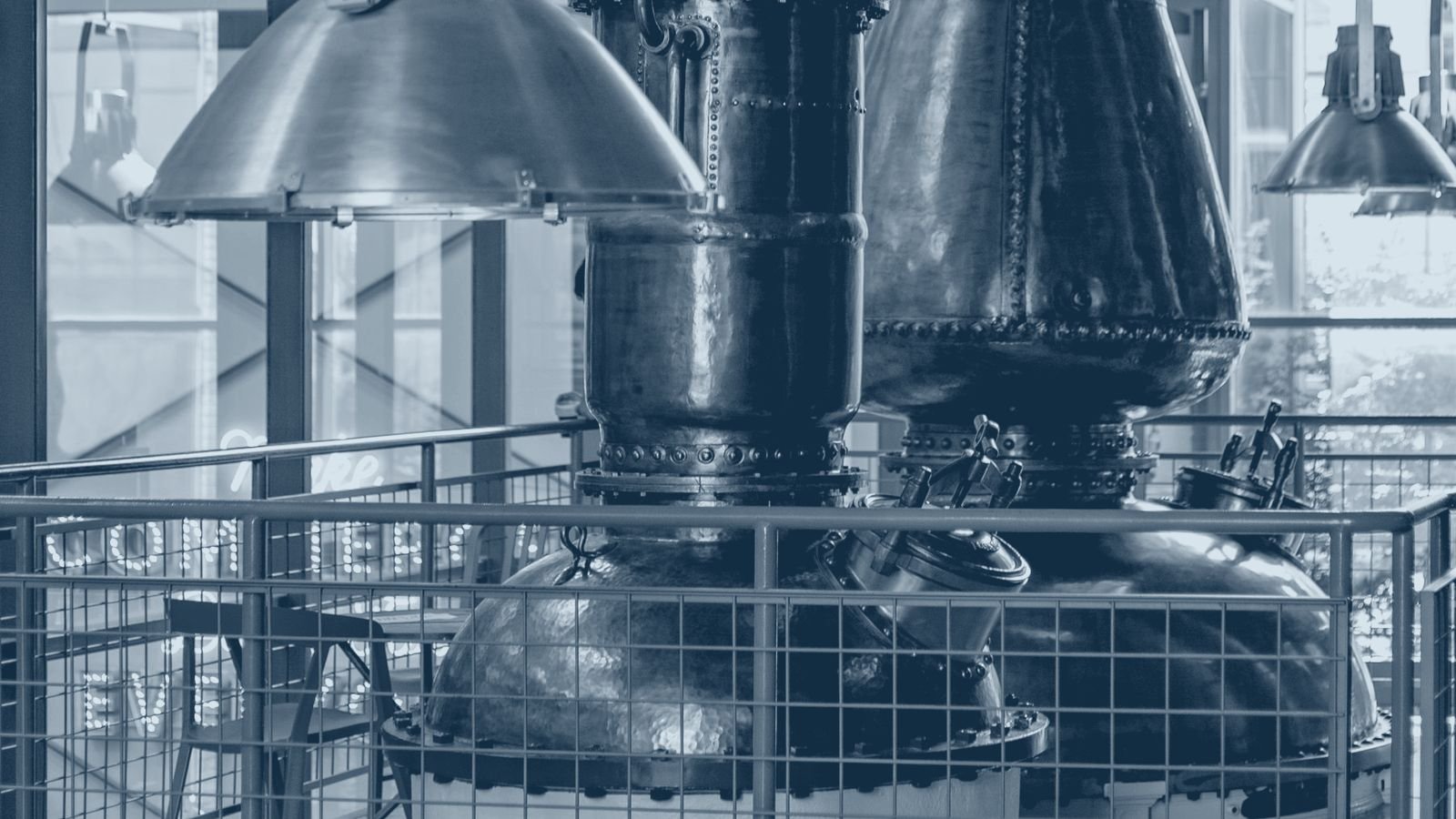
Distilling is a thermal and water process with a very strong effluent.
Mashing, distillation, condensing and cleaning make a distillery one of the most water and steam intensive processes in food and drink. Aqueduct meters every flow, closes the balance, and turns spent wash from a liability into a measured stream.
ZLDmandated for distilleries above defined volumes in India
~20%of steam lost through failed traps without a PM programme
25 to 50%of RO feed leaves as reject
60sto spot a burst once the site is live
Short answer
A distillery consumes water for mashing, dilution, condenser cooling and cleaning, and steam for distillation, and produces spent wash with a very high organic load. In India, distilleries above defined production volumes are explicitly subject to zero liquid discharge orders from CPCB and the state boards, meaning no liquid discharge to water bodies or land. That makes closing the water balance a compliance requirement rather than an efficiency preference.
Distilling is unusual among food and drink processes in that the two largest utilities, water and steam, are both directly part of the product and the process rather than support services. That means efficiency work has to be done carefully: there is a floor below which you cannot go without affecting the spirit. Which is exactly why measurement matters more here, not less.
Distillery spent wash carries an organic load far above ordinary food processing effluent, which is precisely why the sector is singled out for zero liquid discharge treatment in India rather than ordinary consent limits.
What it costsA treatment train sized for an average the plant never runs, and a compliance exposure that scales with production.
02
Condenser cooling is a large, invisible circuit
Condensing the spirit vapour requires substantial cooling water. Where it is once through rather than recirculated, or where a tower is running with poor cycles of concentration, the volumes are significant and rarely separately metered.
What it costsA large water draw that appears only in the total at the boundary.
03
Steam is the process, and it leaks like any other steam system
Distillation is a thermal separation, so steam is not overhead, it is the mechanism. Without a preventive maintenance programme roughly 20 percent of steam leaving the boiler can be lost through failed traps, with distribution losses of 10 to 20 percent more in poorly maintained systems.
What it costsFuel, treated make up water and chemicals, all paid for on the same lost condensate.
04
Cleaning volumes are unmeasured
Vessel, line and tank cleaning between batches is a major water consumer run to fixed recipes and timers rather than to a measured endpoint, exactly as in dairy.
What it costsThe largest controllable water volume on the site, set by a recipe nobody has revisited.
05
Batch processes hide their own variance
Because production is batched, consumption naturally varies, which makes a genuine anomaly extremely hard to see against normal batch to batch variation on a monthly view.
What it costsA leak or a stuck valve is statistically invisible until it is large.
06
Reuse is claimed and rarely metered
Condensate, cooling blowdown, RO reject and treated effluent are all recoverable. RO recovery typically runs 50 to 75 percent, so a quarter to a half of the feed leaves as reject, usually to drain.
What it costsRecoverable volume lost, and a reuse figure that cannot survive an assurance question.
Every utility, mapped
The utility map of a distillery
Distillery utility map
Utility
Where it goes
The usual failure
What Aqueduct meters
Process water
Mashing, dilution, product make up
Metered at the boundary only
Intake by source, per process line flow, with a balance that must reconcile
Condenser cooling
Spirit condensing, heat rejection
Once through operation or poor tower cycles, unmetered
Cooling flow, delta T, tower make up and blowdown, recovery opportunity
Steam and boiler fuel
Distillation, mashing, cleaning
Failed traps, condensate not returned, blowdown unmanaged
Power factor penalties and demand peaks found on the invoice
Feeder level load, power factor, peak demand, transformer losses
Spent wash and effluent
Treatment train, evaporation, reuse, discharge
Shock loads with no attributable cause; ZLD balance not closed
Discharge and reuse flow, load profile, event correlation to the batch that caused it
RO and water treatment
Boiler feed, process polishing
Reject at 25 to 50 percent of feed sent to drain
Feed, permeate and reject flow, recovery percentage, fouling trend
Compressed air
Valves, actuators, packaging
10 to 30 percent of plant electricity, 20 to 40 percent of it leaked
Compressor kW, flow, pressure, off shift baseline as the leak signature
Water and steam are the process here, not overhead, which is why measurement matters more.
The solution
A balance that has to close, which is what ZLD actually requires
Zero liquid discharge is a balance statement before it is a treatment train. Every litre entering the site must be accounted for as product, evaporation, reuse or solid residue. A site that cannot close that balance cannot demonstrate ZLD, whatever its equipment is capable of on paper.
Water
aQ WaterGuard
The balance, reconciled every 60 seconds.
Supply equals process plus cooling plus cleaning plus RO feed plus unaccounted loss
Spent wash and treated effluent quantified by destination, which is the ZLD evidence
Batch aware baselines, so an anomaly is judged against the comparable previous batch
Thermal
aQ EnergySmart
The steam side, closed as its own balance.
Fuel in, steam out, condensate returned, blowdown, as one reconciling loop
Condensate return ratio as the single highest signal number on the site
Condenser cooling efficiency and heat recovery opportunity quantified
Feeder level electricity with power factor and peak demand
Effluent
aQ Core
Attribution, which is what makes shock loads manageable.
An effluent spike traced to the batch, wash or dump that caused it, within minutes
Sequencing insight so heavy discharges are staggered rather than coincident
Alerting when discharge trends toward a consent or ZLD boundary
Audit grade export for pollution control board returns and BRSR
Air
aQ AirSafe
Conditions where people work.
CO2, PM2.5, VOC, temperature and humidity per zone
Ventilation tied to process and occupancy rather than a fixed schedule
Continuous records for compliance and wellbeing without a manual log
Zero liquid discharge is a balance statement before it is a treatment train.
Compliance
The regulatory clock in your markets
Distilleries sit at the strict end of environmental regulation in several of Milvian's markets, because the effluent load is high enough to be treated as a distinct category rather than as general food and drink processing.
What applies, by market
Market
Primary instrument
What it measures
The operational consequence
United States
ASHRAE 90.1, ENERGY STAR benchmarking, city building performance standards
Design compliance, then annual measured benchmarking
Disclosure is becoming performance improvement with penalties attached
Canada
NECB 2020, NRCan national benchmarking
Design compliance for buildings 600 m2 or 4 storeys and above, plus measured benchmarking
Benchmarking against a national dataset needs complete, attributable meter data
United Kingdom
MEES, ESOS, SECR
Asset EPC rating, organisational energy assessment, disclosed consumption and actions
EPC B for commercial above 1,000 m2 from 2031, and ESOS progress reporting to 2027
Middle East
Al Sa'fat, Estidama Pearl, DSM strategy
Green building compliance at permit, increasingly questioned in operation
Al Sa'fat Silver mandatory for new Dubai permits from 2026, 30 percent demand cut by 2030
The rating comes from your meter data and is visible to the market
Summarised for orientation, not as legal advice. Requirements vary by state, emirate, province and municipality, and by building type and size. Confirm the operative requirement for your own assets.
United States
Energy codes, local building performance standards and sector specific ventilation rules.
ASHRAE 90.1 and local codes
The energy standard most state and municipal codes are built on, setting envelope, HVAC, lighting and metering requirements for commercial buildings.
ENERGY STAR benchmarking
Portfolio Manager is the de facto benchmarking system, and a growing number of cities require annual energy and water benchmarking disclosure for buildings above a floor area threshold.
Building performance standards
A number of US cities now go beyond disclosure to mandate performance improvement over time, with penalties attached rather than reporting alone.
Sector specific
Healthcare adds ASHRAE 170, which requires continuous monitoring of operating room temperature and humidity and individual control per room, enforced by CMS and the Joint Commission.
Canada
A national energy code plus the first nationally standardised benchmarking system.
NECB 2020
The National Energy Code of Canada for Buildings sets technical requirements for energy efficient design and construction, applying to buildings of 600 square metres or more, or four storeys or more.
National benchmarking
Natural Resources Canada now operates a national building energy benchmarking initiative, the first nationally standard system built on actual Canadian data for the commercial and institutional sector.
Provincial variation
Codes are adopted provincially, so the operative requirement depends on the province and in some cases the municipality, which is why portfolio owners need per site rather than per country reporting.
What it means operationally
Benchmarking against a national dataset only works if the meter data behind it is complete and attributable, which is where most estates fall short.
United Kingdom
Three separate schemes, and a hard minimum standard arriving in 2031.
MEES
Minimum Energy Efficiency Standards target privately rented commercial property. From 2031 all commercial buildings above 1,000 square metres must reach at least EPC band B, subject to exemptions, which makes an unimproved asset progressively harder to let.
ESOS
A mandatory energy assessment scheme for large organisations. Phase 3 participants must submit an action plan and then report progress against it through to 2027, so the obligation is now continuing rather than a one off audit.
SECR
Streamlined Energy and Carbon Reporting requires large companies to disclose energy use, emissions and the efficiency actions taken, inside the annual report.
What it means operationally
ESOS wants an action plan, SECR wants the actions disclosed, MEES wants the asset to actually improve. All three are far easier to satisfy from metered data than from an assessment carried out every few years.
Middle East
Green building systems that are mandatory at permit, plus national net zero pathways.
Al Sa'fat, Dubai
Dubai Municipality's green building system. From 2026 Al Sa'fat Silver is the mandatory baseline for new building permits, with water conservation measures targeting a 30 to 40 percent reduction in consumption.
Estidama Pearl, Abu Dhabi
The parallel Abu Dhabi rating system, written at design stage and increasingly questioned in operation rather than only at handover.
Demand Side Management
Dubai's DSM strategy targets a 30 percent reduction in electricity and water demand by 2030 against business as usual, extending to 50 percent by 2050.
The physical driver
Up to 80 percent of a building's electricity demand in the UAE goes to cooling, and process water is desalinated, so efficiency and cost sit on the same lever. UAE Net Zero 2050 turns plant efficiency into a reported obligation asset by asset.
India
A building energy code, assured ESG disclosure and a live carbon market.
ECBC
The Energy Conservation Building Code sets minimum standards for commercial buildings with a connected load of 100 kW or a contract demand of 120 kVA or more. Compliance is either prescriptive or by whole building performance simulation, with ECBC+ and SuperECBC as higher voluntary tiers.
BRSR Core
For listed entities, energy and water intensity metrics now carry reasonable assurance from an independent provider, which means an assurance partner traces how each number was derived.
CCTS and PAT
The Carbon Credit Trading Scheme is absorbing the PAT mechanism, with compliance obligations already active across energy intensive sectors and BRSR Core data positioned as an input.
Pollution control
CPCB general standards require outlet BOD at or below 30 mg per litre for inland surface discharge, and state boards now operate real time monitoring with strengthened enforcement powers.
Australia
A measured performance rating with mandatory disclosure, which is unusually strict.
NABERS
The National Australian Built Environment Rating System rates buildings from one to six stars in half star increments, based on measured operational performance rather than design intent, for the base building, the tenancy or the whole building.
Commercial Building Disclosure
Mandatory disclosure for large office buildings has been in place since 2011, and the programme has been expanding. It is widely regarded as a global benchmark for built environment transparency.
NCC Section J
The National Construction Code sets the energy efficiency requirements for new commercial building work.
Why it matters here
NABERS is a measured rating, so it is derived from actual metered consumption. A portfolio that cannot produce clean, attributable meter data cannot improve its rating, and in Australia the rating is publicly disclosed.
Deployment
One line first
Non invasive throughout. We map what exists, flag the gaps and never interrupt production.
Day 0
Survey
Water intakes, process and cooling circuits, CIP, boiler house, condensate return, spent wash handling and the effluent plant. Twelve months of bills.
Week 2
Instrumentation plan
Sensor list, gateway layout and the water and thermal balance model, for sign off.
Week 3 to 8
Phased metering
Clamp on flow, pressure, level and power sensors fitted during normal running.
Day 90
Live and reconciled
Balances close, effluent events attributable, first losses named against the baseline.
Proof
Where this has already run
Global water stewardship
A Fortune 1 water positive programme
One real time water intelligence layer across the estate, with same day leak and anomaly detection replacing bill cycle discovery, and auditable data behind reduce, reuse and replenish reporting.
88 facilities monitored, 75,000 m3 saved
Aviation, United States
A top 25 US airport, live in 72 hours
Roughly 5,000 meter points instrumented across a 24/7 campus. A 9,000 gallon per day anomaly surfaced within 72 hours of go live, a find manual reads would have missed for months.
5,000 meter points, 72 hours to first find
The platform record
175 plus facilities, 19 countries
Hardware agnostic across 130 plus device types and any protocol, reading BACnet, Modbus, MQTT, OPC UA and vendor APIs. AWS Advanced Tier Services Partner with SOC 2 aligned security.
Is zero liquid discharge mandatory for distilleries?
In India, ZLD is mandated under CPCB and state pollution control board orders for certain high load sectors including distilleries above defined production volumes, meaning no liquid discharge to water bodies or land is permitted.
Elsewhere it is generally not a blanket mandate, but ZLD style conditions appear in individual consents, particularly in water scarce regions, and reuse expectations arrive through customer and investor requirements regardless.
How does monitoring help with a ZLD obligation?
ZLD is fundamentally a balance statement: every litre in has to be accounted for as product, evaporation, reuse or solid residue. Demonstrating it requires that balance to close continuously, not on a design drawing.
Continuous metering of intakes, process flows, reuse streams and treated volumes is what allows the balance to be stated and defended. Without it, ZLD is a claim about equipment rather than a demonstrated outcome.
Can you reduce cleaning water without affecting the spirit?
The safe reductions do not touch validated cleaning steps. Recovering the final rinse as the next pre rinse, eliminating cleaning cycles on vessels that were not used, fixing passing valves and correcting sequencing overlap all reduce volume without changing a cleaning protocol.
Recipe changes should follow measured evidence that the cleaning endpoint is consistently reached earlier, and should go through your existing quality process with continuous monitoring left in place afterwards.
Batch production varies a lot. Will monitoring just generate noise?
It will if it is threshold based, which is why the balance approach matters here more than in continuous processes. Instead of alarming when a number crosses a line, the system reconciles a balance and raises the residual.
Comparisons are also made batch to comparable batch rather than against a rolling average, which is a far sharper control in a batched process.
Does installation interrupt production?
No. Clamp on ultrasonic flow meters, current transformers and surface temperature sensors fit while running, and existing meters and PLCs are read over Modbus, BACnet or OPC UA. Anything needing a line break waits for a planned shutdown.