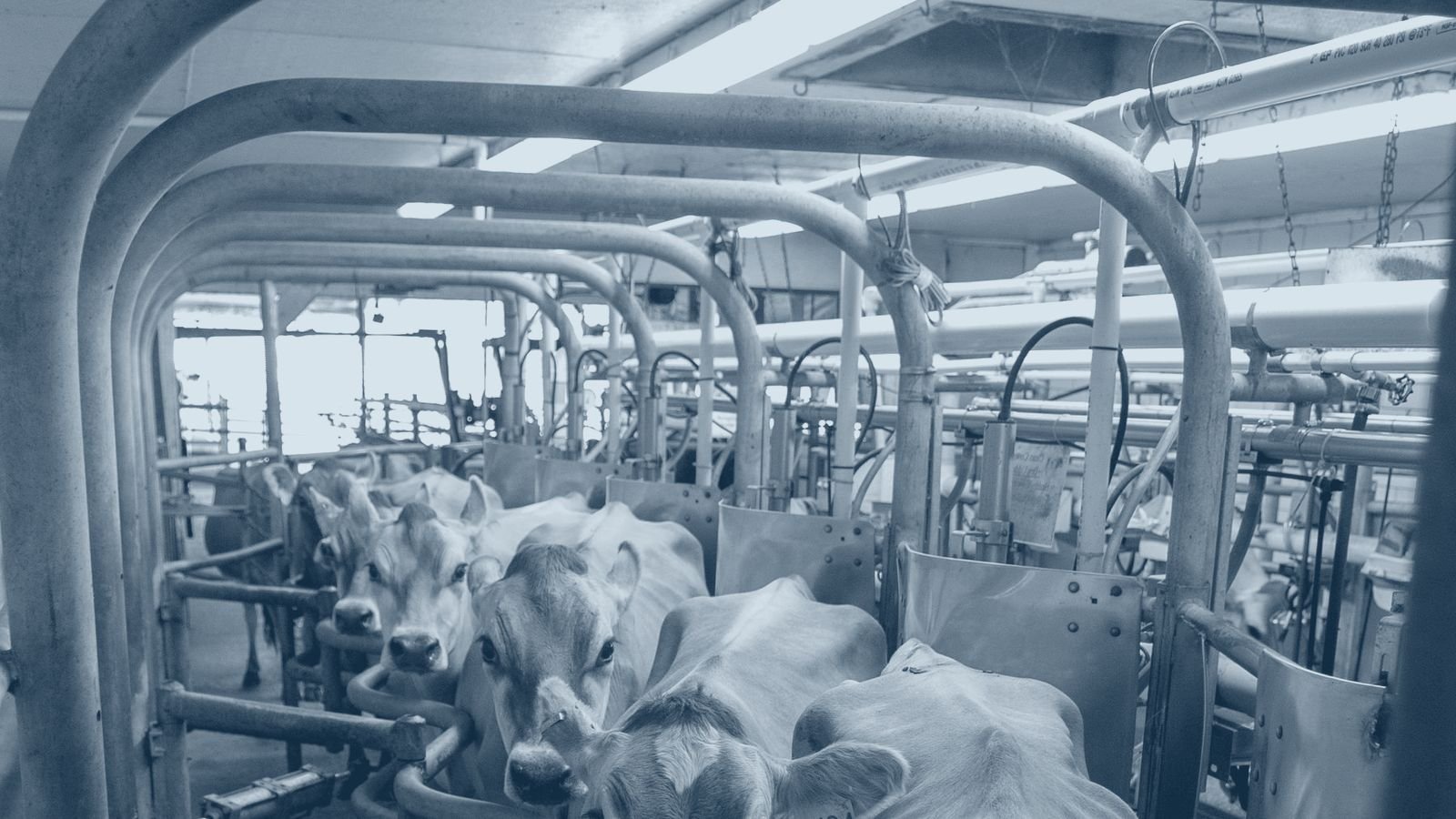
Milk cooling and water heating are most of the electricity on a dairy farm.
The parlour, the plate cooler, the bulk tank and the hot water system are where a dairy farm spends its energy and water. Aqueduct meters them, across one farm or a whole collection network, and catches a failing cooler before the milk is rejected.
On a dairy farm, three loads dominate electricity: milk cooling, water heating for parlour cleaning, and the vacuum pump. The plate cooler sits upstream of the refrigeration and determines how much work it has to do, which makes it the highest leverage asset on the site. Aqueduct meters those loads plus water and milk temperature, over cellular or LoRaWAN where there is no fixed connectivity, across one farm or a whole collection network.
This is a different problem from a dairy processing plant, which is why it is a separate page. A farm has no engineering team, often no reliable connectivity, and a single failure mode that dwarfs all the others: milk that cannot be sold. Monitoring has to earn its place against that, not against a utility bill.
Energy efficiency on a dairy farm is real and worth having. But the reason to instrument a parlour is that a failing cooling chain is discovered at reception, after the collection, when the milk is already unsaleable and a day of production from the farm is gone.
01
The bulk tank fails quietly
A refrigeration unit losing performance still cools, just more slowly and less far. The milk may sit above target for hours without anyone present to see it, and the temperature at the moment of collection may look acceptable.
What it costsA rejected collection is a full day of production from that farm, plus the energy already spent cooling it.
02
The plate cooler is the highest leverage asset and the least watched
A plate cooler uses cold water to drop milk temperature before it reaches the refrigeration system. When flow, water temperature or the heat exchanger surface degrade, the refrigeration silently takes the extra load.
What it costsRefrigeration runs longer and harder for the same result, permanently, and nothing indicates why.
03
Water heating is a large load run on a timer
Parlour cleaning needs hot water on a schedule tied to milking. Heating is often on a simple timer with no relationship to tariff periods or to whether the water is actually needed.
What it costsA significant thermal load run at the most expensive time of day for no operational reason.
04
Vacuum pumps run flat out
Many parlours run fixed speed vacuum pumps continuously through milking regardless of demand, where variable speed control against measured vacuum is well established.
What it costsA continuous motor load sized for peak, run at peak throughout.
05
Nobody can compare farms in a network
For a processor or cooperative drawing from hundreds of farms, the question is which sites are at risk and which are inefficient. Without telemetry there is no ranking, so field engineering attention is allocated by complaint.
What it costsSupport goes to the loudest farm rather than the one about to fail.
06
There is no connectivity and no IT
Farms rarely have reliable fixed internet, an IT function or anyone to maintain a system. Any solution that assumes those things does not survive contact with the site.
What it costsMost monitoring projects at farm level fail on this, not on the sensing.
What gets measured
The parlour, in measurements
Dairy farm measurement map
Asset
Why it matters
What is measured
What it catches
Bulk tank refrigeration
The rejection risk sits here
Compressor power, run hours, milk temperature profile
Slow performance loss, and excursions between manual checks
Plate cooler
Determines the refrigeration load
Water flow and temperature, milk temperature in and out
Fouling, low flow and rising pre cool temperature, before refrigeration absorbs it
Water heating
Large scheduled thermal load
Power and run time against tariff period
Heating at expensive times for no operational reason
Vacuum pump
Continuous motor load
Power, run hours, vacuum level
Fixed speed operation where variable speed would follow demand
Parlour wash water
Largest water use in the parlour
Flow per wash cycle
Over washing, passing valves and hoses left running
Herd drinking water
Largest water use on the farm
Flow to troughs
Trough overflow and underground leaks, which are otherwise invisible
Effluent and slurry
Regulated, and increasingly reported
Volumes handled and applied
Storage headroom and an evidenced record for compliance
Supply availability
Rural power is intermittent
Outage frequency and duration
The case for backup, and the explanation for a temperature excursion
Cooling, water heating and the vacuum pump. Three loads are most of the farm.
The solution
Built for sites with no engineer and no fixed line
Cold chain
Rejection avoidance
The primary job, and the business case.
Continuous milk temperature rather than a reading at collection
Compressor power and run hours, so slow performance loss is visible as a trend
Plate cooler performance monitored upstream, where the problem usually starts
Alerting while the milk is still recoverable and a field engineer can still be sent
Energy
aQ EnergySmart
The three loads that matter, separated.
Cooling, water heating and vacuum measured individually rather than as one farm total
Water heating shifted against tariff periods where the schedule allows
Energy per litre collected, which is the only fair comparison between farms of different size
Variable speed opportunity on vacuum quantified from measured demand
Water
aQ WaterGuard
Two very different draws.
Parlour wash volume per cycle, which is the controllable part
Herd drinking water, where the failure mode is trough overflow and buried leaks
Plate cooler water, and whether it is being recovered for washing or drinking
Effluent and slurry volumes, evidenced for compliance
Network
aQ Core
Hundreds of sites, one view.
Every farm ranked by cooling performance and energy per litre
Missing data flags, so an un instrumented or offline site is obvious
Connected over cellular or LoRaWAN with local buffering, so a connectivity gap delays data rather than losing it
Field engineering directed to the sites at risk rather than the sites complaining
Farms repeat, which is what makes a whole collection network affordable to instrument.
Compliance
The regulatory clock in your markets
Farm level regulation is driven mainly by effluent, nutrient management and water abstraction, and increasingly by the disclosure obligations of the processors and retailers buying the milk, which flow down the supply chain as data requests.
What applies, by market
Market
Primary instrument
What it measures
The operational consequence
United States
ASHRAE 90.1, ENERGY STAR benchmarking, city building performance standards
Design compliance, then annual measured benchmarking
Disclosure is becoming performance improvement with penalties attached
Canada
NECB 2020, NRCan national benchmarking
Design compliance for buildings 600 m2 or 4 storeys and above, plus measured benchmarking
Benchmarking against a national dataset needs complete, attributable meter data
United Kingdom
MEES, ESOS, SECR
Asset EPC rating, organisational energy assessment, disclosed consumption and actions
EPC B for commercial above 1,000 m2 from 2031, and ESOS progress reporting to 2027
Middle East
Al Sa'fat, Estidama Pearl, DSM strategy
Green building compliance at permit, increasingly questioned in operation
Al Sa'fat Silver mandatory for new Dubai permits from 2026, 30 percent demand cut by 2030
The rating comes from your meter data and is visible to the market
Summarised for orientation, not as legal advice. Requirements vary by state, emirate, province and municipality, and by building type and size. Confirm the operative requirement for your own assets.
United States
Energy codes, local building performance standards and sector specific ventilation rules.
ASHRAE 90.1 and local codes
The energy standard most state and municipal codes are built on, setting envelope, HVAC, lighting and metering requirements for commercial buildings.
ENERGY STAR benchmarking
Portfolio Manager is the de facto benchmarking system, and a growing number of cities require annual energy and water benchmarking disclosure for buildings above a floor area threshold.
Building performance standards
A number of US cities now go beyond disclosure to mandate performance improvement over time, with penalties attached rather than reporting alone.
Sector specific
Healthcare adds ASHRAE 170, which requires continuous monitoring of operating room temperature and humidity and individual control per room, enforced by CMS and the Joint Commission.
Canada
A national energy code plus the first nationally standardised benchmarking system.
NECB 2020
The National Energy Code of Canada for Buildings sets technical requirements for energy efficient design and construction, applying to buildings of 600 square metres or more, or four storeys or more.
National benchmarking
Natural Resources Canada now operates a national building energy benchmarking initiative, the first nationally standard system built on actual Canadian data for the commercial and institutional sector.
Provincial variation
Codes are adopted provincially, so the operative requirement depends on the province and in some cases the municipality, which is why portfolio owners need per site rather than per country reporting.
What it means operationally
Benchmarking against a national dataset only works if the meter data behind it is complete and attributable, which is where most estates fall short.
United Kingdom
Three separate schemes, and a hard minimum standard arriving in 2031.
MEES
Minimum Energy Efficiency Standards target privately rented commercial property. From 2031 all commercial buildings above 1,000 square metres must reach at least EPC band B, subject to exemptions, which makes an unimproved asset progressively harder to let.
ESOS
A mandatory energy assessment scheme for large organisations. Phase 3 participants must submit an action plan and then report progress against it through to 2027, so the obligation is now continuing rather than a one off audit.
SECR
Streamlined Energy and Carbon Reporting requires large companies to disclose energy use, emissions and the efficiency actions taken, inside the annual report.
What it means operationally
ESOS wants an action plan, SECR wants the actions disclosed, MEES wants the asset to actually improve. All three are far easier to satisfy from metered data than from an assessment carried out every few years.
Middle East
Green building systems that are mandatory at permit, plus national net zero pathways.
Al Sa'fat, Dubai
Dubai Municipality's green building system. From 2026 Al Sa'fat Silver is the mandatory baseline for new building permits, with water conservation measures targeting a 30 to 40 percent reduction in consumption.
Estidama Pearl, Abu Dhabi
The parallel Abu Dhabi rating system, written at design stage and increasingly questioned in operation rather than only at handover.
Demand Side Management
Dubai's DSM strategy targets a 30 percent reduction in electricity and water demand by 2030 against business as usual, extending to 50 percent by 2050.
The physical driver
Up to 80 percent of a building's electricity demand in the UAE goes to cooling, and process water is desalinated, so efficiency and cost sit on the same lever. UAE Net Zero 2050 turns plant efficiency into a reported obligation asset by asset.
India
A building energy code, assured ESG disclosure and a live carbon market.
ECBC
The Energy Conservation Building Code sets minimum standards for commercial buildings with a connected load of 100 kW or a contract demand of 120 kVA or more. Compliance is either prescriptive or by whole building performance simulation, with ECBC+ and SuperECBC as higher voluntary tiers.
BRSR Core
For listed entities, energy and water intensity metrics now carry reasonable assurance from an independent provider, which means an assurance partner traces how each number was derived.
CCTS and PAT
The Carbon Credit Trading Scheme is absorbing the PAT mechanism, with compliance obligations already active across energy intensive sectors and BRSR Core data positioned as an input.
Pollution control
CPCB general standards require outlet BOD at or below 30 mg per litre for inland surface discharge, and state boards now operate real time monitoring with strengthened enforcement powers.
Australia
A measured performance rating with mandatory disclosure, which is unusually strict.
NABERS
The National Australian Built Environment Rating System rates buildings from one to six stars in half star increments, based on measured operational performance rather than design intent, for the base building, the tenancy or the whole building.
Commercial Building Disclosure
Mandatory disclosure for large office buildings has been in place since 2011, and the programme has been expanding. It is widely regarded as a global benchmark for built environment transparency.
NCC Section J
The National Construction Code sets the energy efficiency requirements for new commercial building work.
Why it matters here
NABERS is a measured rating, so it is derived from actual metered consumption. A portfolio that cannot produce clean, attributable meter data cannot improve its rating, and in Australia the rating is publicly disclosed.
Proof
Where this has already run
Dairy, Andhra Pradesh
One of the state's largest dairy operations
Process water, cleaning circuits, refrigeration and thermal balance instrumented across the operation, with the collection network treated as sites in the same portfolio as the plant.
One real time water intelligence layer across the estate, with same day leak and anomaly detection replacing bill cycle discovery, and auditable data behind reduce, reuse and replenish reporting.
88 facilities monitored, 75,000 m3 saved
Aviation, United States
A top 25 US airport, live in 72 hours
Roughly 5,000 meter points instrumented across a 24/7 campus. A 9,000 gallon per day anomaly surfaced within 72 hours of go live, a find manual reads would have missed for months.
5,000 meter points, 72 hours to first find
The platform record
175 plus facilities, 19 countries
Hardware agnostic across 130 plus device types and any protocol, reading BACnet, Modbus, MQTT, OPC UA and vendor APIs. AWS Advanced Tier Services Partner with SOC 2 aligned security.
2 to 6 weeks from first call to live data
Questions
Dairy farm monitoring: frequently asked questions
What uses the most electricity on a dairy farm?
Three loads dominate: milk cooling, water heating for parlour cleaning, and the vacuum pump. Lighting and other loads are comparatively minor.
Because those three are the whole picture, metering them individually rather than taking a farm total is what makes improvement possible at all.
Why focus on the plate cooler?
Because it sits upstream of the refrigeration and determines how much work the refrigeration has to do. Milk arriving at the bulk tank warmer than it should be means the compressor runs longer for the same outcome.
A plate cooler degrades quietly through fouling, low water flow or rising water temperature, and the only symptom is that refrigeration works harder. Measuring it directly catches the cause rather than the consequence.
How does this work with no internet on the farm?
Over cellular or LoRaWAN rather than fixed connectivity, with local buffering so a coverage gap delays data rather than losing it. Coverage is confirmed during the survey before any commitment.
Nothing on the farm requires an IT function or on site maintenance, which is the constraint that defeats most farm level monitoring projects.
Can this be rolled out across a whole collection network?
Yes, and that is where the value concentrates. Because parlours repeat, instrumentation becomes a standard kit rather than a bespoke design per site, so the cost per farm falls sharply after the first.
Each farm appears in one portfolio ranked on cooling performance and energy per litre, with missing data flagged until a site is online.
What is the actual return?
Energy savings on cooling, water heating and vacuum are real and measurable. But the case usually rests on rejection avoidance, because a rejected collection is a full day of production from that farm plus the energy already spent cooling it.
One avoided rejection per farm per year across a large network typically covers the programme, and the energy saving is upside.