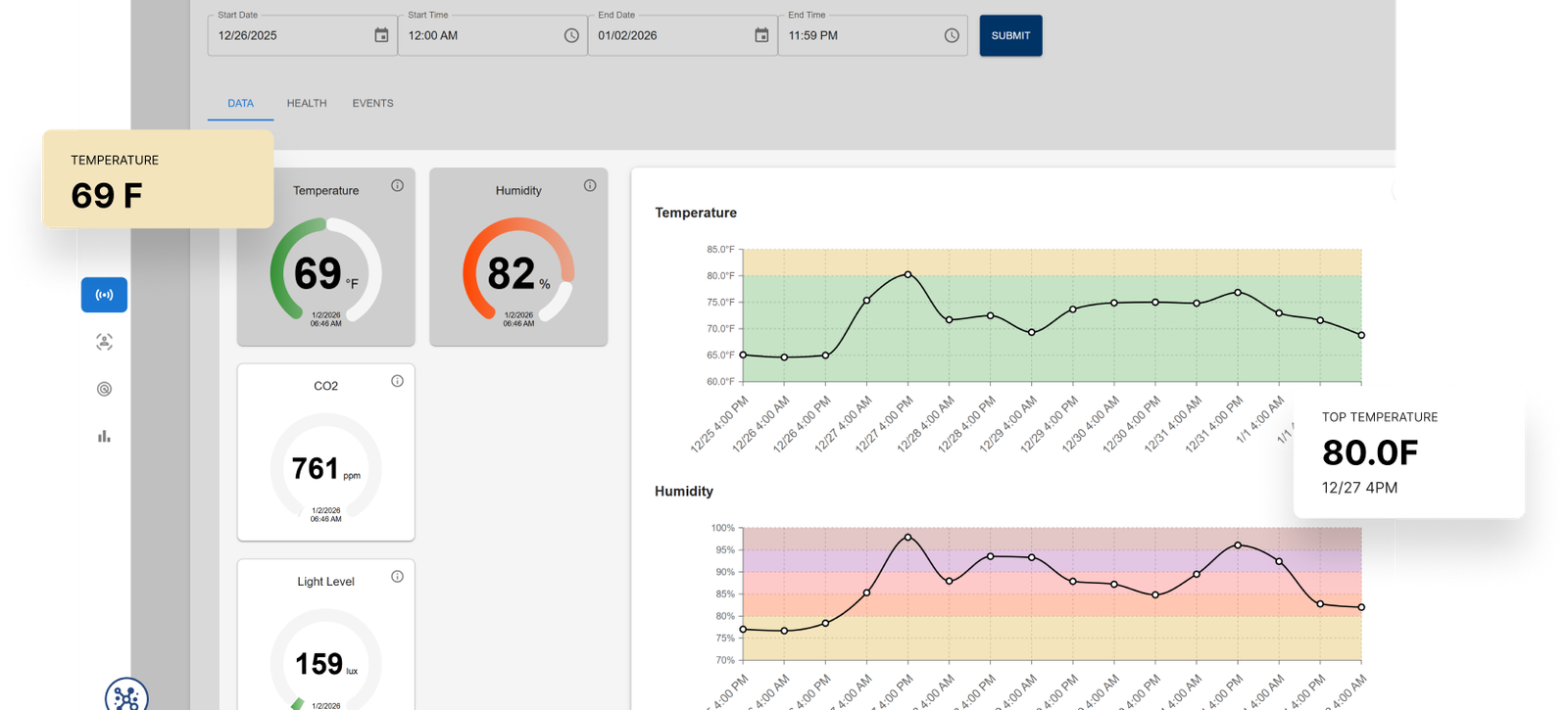
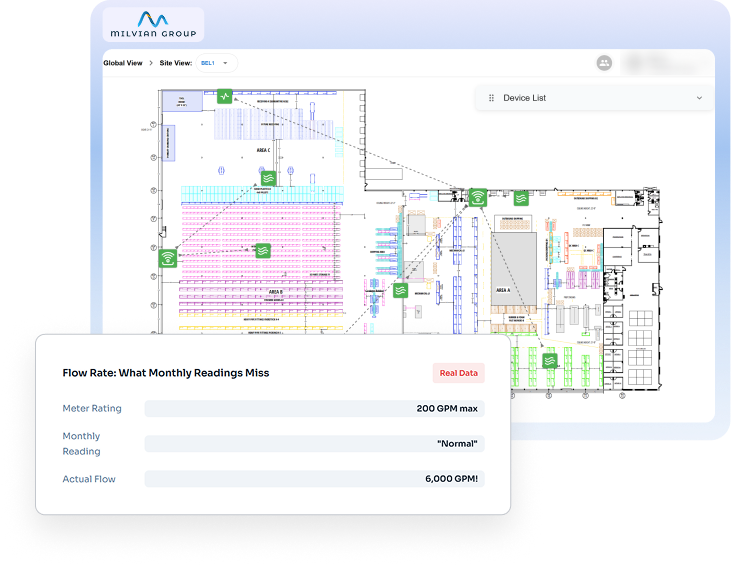
The average person spends 90% of their time indoors. Indoor pollutant concentrations can be 2–5× higher than outdoor levels. Yet most buildings monitor air quality quarterly at best or only when occupants complain.
Research from Harvard's T.H. Chan School shows that improved ventilation and IAQ correlates with 8–11% productivity gains and 35% fewer sick building syndrome symptoms. For a 500-person office, that translates to $3.5M+ in annual productivity value. The buildings that measure it, manage it and attract the tenants willing to pay premium rents for it.
INDUSTRY CHALLENGES
Quarterly spot-checks and complaint-driven responses leave occupants exposed and compliance at risk. Aqueduct makes the invisible visible.
OSHA, EPA, WELL, LEED, and local regulations require specific air quality thresholds but quarterly spot-checks capture a single moment in time. COâ‚‚ may spike for 3 hours daily in conference rooms. VOCs may exceed limits every afternoon. Your compliance report shows the one hour it was measured, not the 8,759 hours it wasn't.
Headaches. Fatigue. Difficulty concentrating. 30% of commercial buildings have significant IAQ issues. Occupants feel the effects but can't articulate the cause. COâ‚‚ above 1,000 ppm reduces cognitive function by 15%. Above 1,500 ppm, decision-making drops 50%. Your HVAC system doesn't know the difference.
Gas leaks start small a loose fitting, a degraded seal, a valve that doesn't close completely. By the time it's detectable by smell, concentrations may already be in the danger zone. Refrigerant leaks waste thousands in operating costs while degrading air quality. Without continuous monitoring, the first alert is often the emergency.
THE AQUEDUCT APPROACH
Continuous multi-parameter monitoring that protects occupant health, ensures regulatory compliance, and provides the data to prove both.

COâ‚‚, VOCs, PM2.5, PM10, temperature, humidity, CO, NOâ‚‚, formaldehyde, and radon all from a single sensor platform per zone.
Algorithms correlate occupancy patterns, outdoor conditions, and indoor readings to recommend real-time ventilation adjustments.
Continuous data logging with automated report generation for WELL, LEED, OSHA, EPA, and local regulatory requirements.
Tiered alert system from advisory notifications to emergency escalations. Gas leak detection triggers immediate safety protocols.
Unified Infrastructure Intelligence
Avg. IAQ improvement
Compliance documentation rate
Reduction in SBS symptoms
Productivity gain correlation
COMPLIANCE FRAMEWORKS SUPPORTED
Aqueduct continuously monitors against the thresholds and documentation requirements of major compliance frameworks so you're never scrambling before an audit.
Continuous air quality monitoring, thermal comfort, and humidity tracking aligned with WELL v2 Air, Thermal Comfort, and Sound concepts.
Indoor Environmental Quality (IEQ) credits supported with continuous COâ‚‚, VOC, and PM monitoring and automated documentation.

Permissible Exposure Limits (PEL) monitoring for workplace air quality, gas detection, and automated compliance record-keeping.
NAAQS alignment, radon monitoring, and air quality index tracking with automated exceedance notifications and remediation logging.
Scope 1 and 2 emissions data collection, energy and water consumption tracking, and automated ESG metric generation for annual reporting.
ASHRAE 62.1 ventilation rate monitoring, differential pressure tracking for sensitive spaces, and infection control air quality parameters.
PLATFORM CAPABILITIES
Air quality, gas safety, thermal comfort, and compliance unified in a single dashboard with AI-powered insights and automated controls.
Industry Insight: The COâ‚‚ Cognition
Cliff
Research from Harvard and SUNY demonstrates a stark relationship between COâ‚‚ levels and
cognitive performance. At 1,000 ppm (common in poorly ventilated offices post-lunch), cognitive
scores drop 15%. At 1,500 ppm, decision-making performance drops 50%. Most conference rooms
exceed 1,500 ppm within 45 minutes of a 6-person meeting. Yet without continuous monitoring,
facilities teams have no idea this is happening. The cost isn't just discomfort it's
measurable productivity loss. One Aqueduct client discovered their main conference center spent
4+ hours daily above 1,200 ppm, correlating with a measurable drop in post-meeting task
completion rates.
✓ Verified Pilot Results
How Aqueduct transformed a healthcare campus from reactive IAQ management to proactive environmental control achieving WELL certification and eliminating compliance gaps.
3 Buildings • 420 Beds • Lab, Pharmacy & Surgical Suites
Zones Monitored
Days to Insights
Critical Issues Found
Operational Disruption
Time to actionable environmental insights
Safety and compliance issues detected
Certification achieved through continuous data
Annual compliance audit prep eliminated
Staff health and IAQ-related complaints
Schedule a personalized demo to see Aqueduct monitor air quality, detect gas leaks, automate compliance documentation, and surface insights your quarterly reports miss. We'll show you how to protect occupant health and ensure your facility is always audit-ready with a custom implementation plan and ROI projection.
© 2026 Milvian Group. All rights reserved.